Poster · 2026-10-20
Deliberate Workflows. Why Small Decisions Define the SHAPE of Modern Research Data Processing
Metadata, materials & relationships
- Format
- Poster / poster
- Published
- 2026-10-20 (day precision)
- Version
- 0.9.11
- All versions
- 10.5281/zenodo.23127196 · Version history
- License
- cc-by-4.0
- Original language
- eng
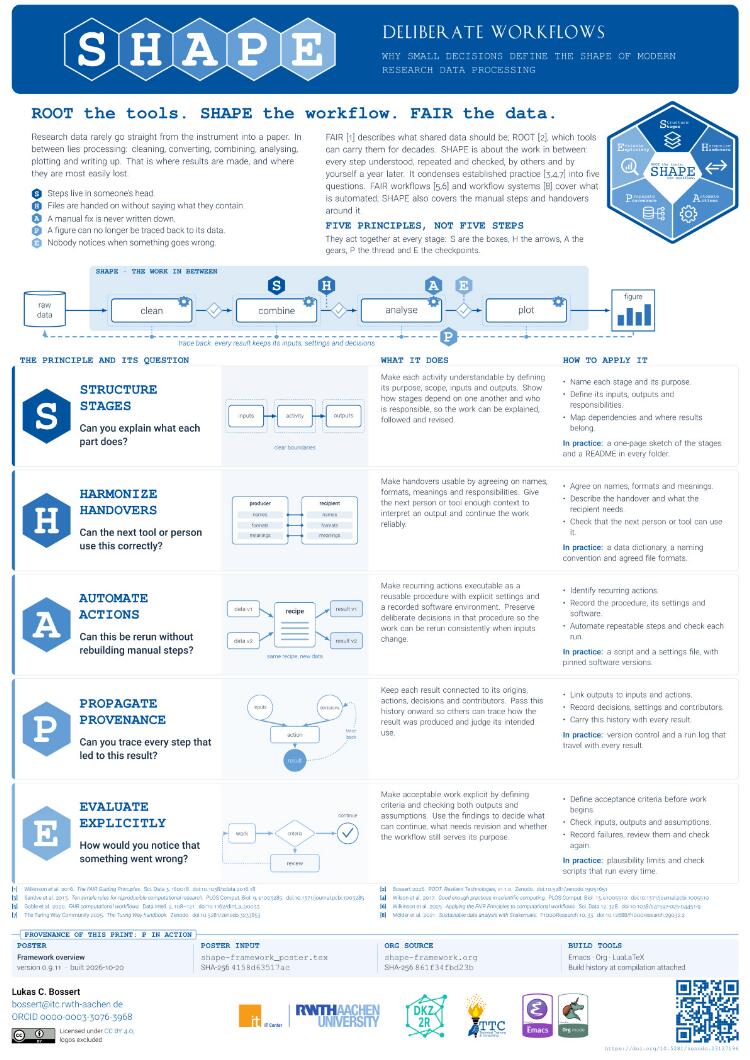
Research data rarely go straight from an instrument into a publication. Cleaning, converting, combining, analysing, plotting and writing up are where results take shape, but also where undocumented decisions, ambiguous handovers and manual interventions can make them difficult to trace or repeat. SHAPE introduces five principles for making this processing work explicit, understandable and open to checking: Structure Stages: Define each activity's purpose, inputs, outputs and responsibilities, and make dependencies between stages visible. Harmonize Handovers: Agree on names, formats and meanings so that the next person or tool can interpret and use an output correctly. Automate Actions: Turn recurring actions into executable procedures, recording the settings and decisions needed to run them again. Propagate Provenance: Keep results connected to their inputs, actions, decisions and contributors, and carry that history forward. Evaluate Explicitly: Define acceptance criteria, check inputs and outputs, and review failures and assumptions throughout the work. The five principles apply throughout a workflow; they are not a fixed sequence of steps. Activities such as collecting, cleaning, comparing, combining and collaborating can each involve all five. Adapt the activities to your workflow and revisit the principles whenever inputs, methods, responsibilities or intended uses change. SHAPE complements the FAIR Guiding Principles for findable, accessible, interoperable and reusable research objects and ROOT , which emphasises Robust, Open, Ongoing and Time-tested tools. SHAPE focuses on how processing work is organised so that others, and your future self, can understand, repeat and check it. It condenses established practical advice, such as the ten simple rules for reproducible computational research , good enough practices in scientific computing and The Turing Way , into five questions, and speaks of provenance in the terms of W3C PROV . Each principle acts in its own place: inside each stage, between stages, on every rerun, along the chain and at every checkpoint. SHAPE's nearest neighbours are the FAIR Principles applied to computational workflows and workflow management systems such as Snakemake . They make the automated part of the work findable, reusable and rerunnable. SHAPE also covers the manual steps and handovers around it, and asks whether the work is correct and repeatable: quality and reproducibility, which the FAIR workflow recommendations name as beyond their scope. This deposit contains two complementary A0 portrait posters and a one-page self-check: Framework overview: Introduces the five principles through the problems they prevent, an overview of how they act together in one workflow between FAIR and ROOT, and a card per principle with its guiding question, an abstract diagram, an explanation, practical actions and a line in practice, without relying on a particular discipline or dataset. Workflow example: Applies SHAPE to the creation of the posters themselves. It maps the five principles across authoring, tangling, generation, compilation, checking and packaging, with excerpts from the actual source and build history. Self-check: One A4 page that rates a workflow on the five questions. Level 0 is the problem a principle prevents; levels 1 to 3 are written down, automated and checked. Rating again later shows what changed. Both posters are generated from one Org-mode source using Emacs/Org, Make and LuaLaTeX. The accompanying source bundle includes the source, build instructions, assets, validation results and checksums needed to inspect and rebuild the posters. Each PDF embeds a build-history snapshot captured at compilation; the completed history, including later checking and packaging, is recorded in the repository. The shared release version is 0.9.11 . References Wilkinson, M. D. et al. (2016). The FAIR Guiding Principles for scientific data management and stewardship. Scientific Data, 3, 160018. doi:10.1038/sdata.2016.18 . Bossert, L. C. (2026). Resilient Technologies. Why Decades-Old Tools Define the ROOT of Modern Research Data Management. Version 1.1.0. Zenodo. doi:10.5281/zenodo.19051651 . Sandve, G. K., Nekrutenko, A., Taylor, J. and Hovig, E. (2013). Ten Simple Rules for Reproducible Computational Research. PLOS Computational Biology, 9(10), e1003285. doi:10.1371/journal.pcbi.1003285 . Wilson, G., Bryan, J., Cranston, K., Kitzes, J., Nederbragt, L. and Teal, T. K. (2017). Good enough practices in scientific computing. PLOS Computational Biology, 13(6), e1005510. doi:10.1371/journal.pcbi.1005510 . Goble, C., Cohen-Boulakia, S., Soiland-Reyes, S., Garijo, D., Gil, Y., Crusoe, M. R., Peters, K. and Schober, D. (2020). FAIR Computational Workflows. Data Intelligence, 2(1–2), 108–121. doi:10.1162/dint_a_00033 . Wilkinson, S. R., Aloqalaa, M., Belhajjame, K. et al. (2025). Applying the FAIR Principles to computational workflows. Scientific Data, 12, 328. doi:10.1038/s41597-025-04451-9 . The Turing Way Community (2025). The Turing Way: A handbook for reproducible, ethical and collaborative research. Zenodo. doi:10.5281/zenodo.3233853 . Mölder, F., Jablonski, K. P., Letcher, B. et al. (2021). Sustainable data analysis with Snakemake. F1000Research, 10, 33. doi:10.12688/f1000research.29032.2 . Lebo, T., Sahoo, S. and McGuinness, D. (eds.) (2013). PROV-O: The PROV Ontology. W3C Recommendation, 30 April 2013. https://www.w3.org/TR/prov-o/ .
Original keywords and preserved bibliography tags: data, framework, data processing, ROOT
Materials
Relationships & evidence
- authoredBy → Lukas C. Bossert
Evidence · imported
Source: metadata.creators[0].
Statement source version: 10.5281/zenodo.23493248
Affiliation in the source record: RWTH Aachen University
- taggedWith → data
Evidence · derived
Source: metadata.keywords / legacy.tags / legacy.categories. Exact case-insensitive keyword alias; original terms retained.
Statement source version: 10.5281/zenodo.23493248
- taggedWith → framework
Evidence · derived
Source: metadata.keywords / legacy.tags / legacy.categories. Exact case-insensitive keyword alias; original terms retained.
Statement source version: 10.5281/zenodo.23493248
- taggedWith → Data processing & querying
Evidence · derived
Source: metadata.keywords / legacy.tags / legacy.categories. Exact case-insensitive keyword alias; original terms retained.
Statement source version: 10.5281/zenodo.23493248
- taggedWith → ROOT
Evidence · derived
Source: metadata.keywords / legacy.tags / legacy.categories. Exact case-insensitive keyword alias; original terms retained.
Statement source version: 10.5281/zenodo.23493248
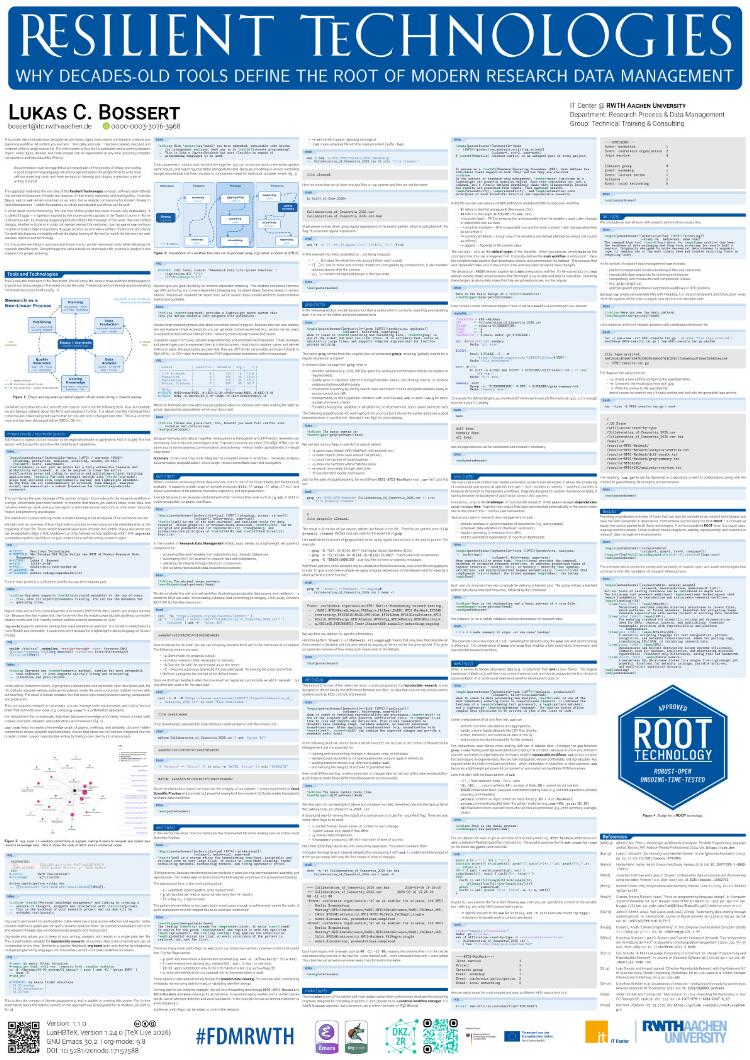
- isSupplementedBy → Resilient Technologies. Why Decades-Old Tools Define the ROOT of Modern Research Data Management
Evidence · imported
Source: metadata.related_identifiers[0].
Original target reference: 10.5281/zenodo.19051651
Statement source version: 10.5281/zenodo.23493248
Original relation: isSupplementedBy
- explains → SHAPE
Evidence · editorial
Source: editorial/research/enrichment.json.edges[1]. SHAPE framework poster and self-check explain the five workflow principles.
Statement source version: 10.5281/zenodo.23493248
- recordedIn → Research outputs
Evidence · editorial
Source: scripts/research/profile-nodes.mjs; canonical item kind=work. This item is part of the corresponding existing website content collection.
Statement source version: 2026-11-08
- taggedWith → Reproducible workflows
Evidence · editorial
Source: content/knowledge/works/zenodo-23127196.md.connections[0]. The framework explicitly addresses the correctness and repeatability of research workflows. Evidence: metadata.description. Reviewed 9 November 2026.
Statement source version: 10.5281/zenodo.23493248
- taggedWith → Metadata & provenance
Evidence · editorial
Source: content/knowledge/works/zenodo-23127196.md.connections[1]. One of the five principles keeps processing results connected to inputs, actions, decisions and contributors. Evidence: metadata.description. Reviewed 9 November 2026.
Statement source version: 10.5281/zenodo.23493248
- taggedWith → Open science & FAIR
Evidence · editorial
Source: content/knowledge/works/zenodo-23127196.md.connections[2]. The description positions SHAPE alongside FAIR for reusable research objects and computational workflows. Evidence: metadata.description. Reviewed 9 November 2026.
Statement source version: 10.5281/zenodo.23493248
- usesTool → GNU Emacs
Evidence · editorial
Source: content/knowledge/works/zenodo-23127196.md.connections[3]. The description explicitly names the tool in the actual source and build chain used to generate both posters. Evidence: metadata.description. Reviewed 9 November 2026.
Statement source version: 10.5281/zenodo.23493248
- usesTool → Org mode & Babel
Evidence · editorial
Source: content/knowledge/works/zenodo-23127196.md.connections[4]. The description explicitly names the tool in the actual source and build chain used to generate both posters. Evidence: metadata.description. Reviewed 9 November 2026.
Statement source version: 10.5281/zenodo.23493248
- usesTool → GNU Make
Evidence · editorial
Source: content/knowledge/works/zenodo-23127196.md.connections[5]. The description explicitly names the tool in the actual source and build chain used to generate both posters. Evidence: metadata.description. Reviewed 9 November 2026.
Statement source version: 10.5281/zenodo.23493248
- usesTool → LaTeX
Evidence · editorial
Source: content/knowledge/works/zenodo-23127196.md.connections[6]. The description explicitly names the tool in the actual source and build chain used to generate both posters. Evidence: metadata.description. Reviewed 9 November 2026.
Statement source version: 10.5281/zenodo.23493248
Metadata: imported · metadata · retrieved 2026-11-08T21:08:36.495Z
Cite this version / BibTeX
Bossert, Lukas C.. 2026-10-20. Deliberate Workflows. Why Small Decisions Define the SHAPE of Modern Research Data Processing. Version 0.9.11. https://doi.org/10.5281/zenodo.23493248
@misc{work-zenodo-23127196,
  title = {Deliberate Workflows. Why Small Decisions Define the SHAPE of Modern Research Data Processing},
  author = {Bossert, Lukas C.},
  year = {2026},
  date = {2026-10-20},
  doi = {10.5281/zenodo.23493248},
  url = {https://doi.org/10.5281/zenodo.23493248},
  version = {0.9.11},
  note = {Poster}
}
Download BibTeX